


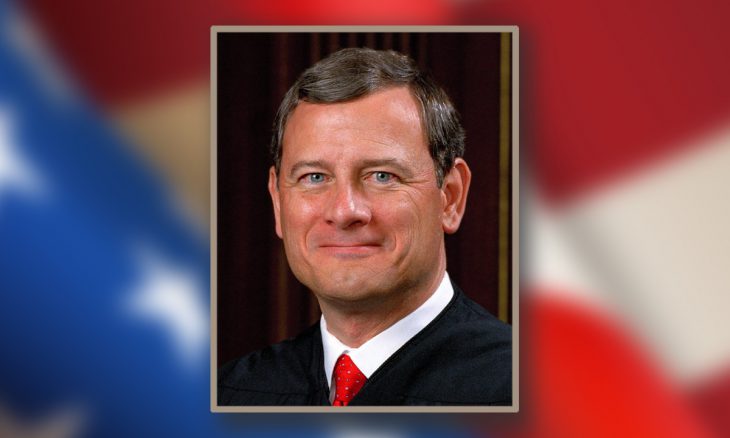
Chief Justice John Roberts
Supreme Court of the United States
John Glover Roberts, Jr., was born in January 1955 in Buffalo, New York, and grew up in Indiana. He earned an undergraduate degree from Harvard College and was preparing to pursue a Ph.D. in history, but decided to attend Harvard Law School instead, where he received his Juris Doctor. He clerked at the Second Circuit U.S. Court of Appeals, then clerked for Justice William Rehnquist of the Supreme Court.
Roberts served as a special assistant to U.S. Attorney General William French Smith and was then an associate with the White House Counsel during President Reagan’s administration. He entered private practice in Washington, D.C. He joined the administration of President George H.W. Bush as Principal Deputy Solicitor General. At the end of that administration, he returned to private practice.
Roberts was nominated by President George W. Bush to a seat on the U.S. Court of Appeals for the D.C. Circuit. After his first nomination expired, he was renominated and confirmed by the Senate. Roberts received his commission in June 2003.
In June 2005, President Bush named Roberts to fill a Supreme Court vacancy created by the retirement of Justice Sandra Day O’Connor. While his nomination was pending, Chief Justice Rehnquist died. Two days later, President Bush withdrew Roberts’ nomination as O’Connor’s successor and announced Roberts’ new nomination to the position of Chief Justice. He was confirmed by the Senate and took his oath of office in September 2005.
Roberts is married to Jane Sullivan, and they have two adopted children. He is Catholic.
In the News…
Chief Justice John Roberts wrote the recent opinions that upheld the president’s authority to remove the heads of certain federal agencies while ruling against his ability to fire a Federal Reserve Board governor over allegations of mortgage fraud.
The decision allowing the president to remove leaders of independent agencies, such as the Federal Trade Commission, essentially overturns a 1935 Supreme Court decision that determined Congress had limited such presidential actions to removal “for cause” only.
Chief Justice Roberts wrote, “Although it is up to the Senate to decide whether to confirm those with whom the President would prefer to work, neither Congress nor the courts may saddle him with those with whom he cannot work. Subordinates who exercise the President’s power are subject to removal by him. Then, and only then, can they remain accountable to the President, and the President to the people.”
However, in a separate case, the high court determined that Congress had limited the president’s ability to remove Federal Reserve Board governors.
Chief Justice Roberts wrote in that opinion, “Any change in that scheme must come from Congress, not the courts. That is why we cannot accept the government’s contentions in this case. To do so would allow the president to remove a member of the Federal Reserve at any time, for any reason, without any notice before, and without any judicial check after. That would turn for-cause protection into little more than at-will employment.”
Contact this Leader…
Did you pray for Chief Justice Roberts today? You can let him know at:
The Honorable Chief Justice John Roberts
Supreme Court of the United States
1 First Street NE
Washington, DC 20543